Blue Carbon: importance and dynamics
Menart, Océane. M.Sc. Student in Oceanography, Biology and Marine Ecology (University of Marseille)
Tolosa, Mariona. Practicum Student. B.Sc in Environmental Sciences (University of Girona)
Carbon dioxide is a gas that is part of the natural carbon cycle through the biological processes of respiration, decomposition, erosion of rocks, and volcanism. Blue carbon is a term that refers to the organic carbon captured and stored for long periods of time (fundamentally, buried) by marine ecosystems. This concept has sparked the development of various research lines over the past decade. Its importance lies in the process of carbon sequestration and burial by coastal ecosystems dominated by vascular plants, and the positive implications of this phenomenon in controlling excess atmospheric CO₂.2 globalmente.
Within blue carbon sequestered by the sea, more than half occurs in coastal ecosystems such as marshes, seagrass, mangroves and estuaries (Nelleman et al., 2009). On the one hand, at the ecological level, we have that forest of marine angiosperms form biodiversity refuges for other species (Serrano et al., 2017) At the same time, their rhizomes prevent or slow down soil erosion processes.On the other hand, these bosques also capture atmospheric CO2 With photosynthesis, where carbon is stored in the form of biomass. y necromasa (Mazarrasa et al., 2015) or driven to the sediments as oxygen is released into the environment. Esta función representa una contribución significativa the mitigation of climate change because it contributes to the reduction of atmospheric CO2, a gas that contributes to global warming (López-Merino et al. 2017).

Graphic 1. Mean carbon storage above and below ground in coastal ecosystems versus terrestrial forest. Searched at http://thebluecarboninitiative.org/blue-carbon/ on 13-02-2017.
That is the reason why conservation is of great importance. Some of these habitats are in danger of degradation, which would involve the release of the carbon they store and, combined with oxygen, would result in high levels of CO.2 that would return to the atmosphere (Lovelock et al., 2017; Rozaimi et al., 2016).
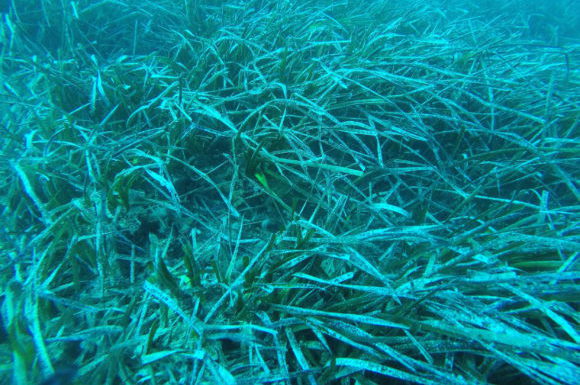
TThis article focuses on seagrasses. Seagrasses are flowering plants that grow in marine and estuarine areas. They are common in intertidal and shallow waters to depths of about 20 m, where there is sufficient light for them to grow. Seagrasses Meadows are primary producers growing on light, nutrients, water and CO2.2With this process, they transform matter from inorganic to organic, acquire the energy they need to function, and release O.2 in the environment. Seagrasses are found wWorldwide with the exception of polar and sub-polar areas or near the influence of the plume of large rivers. Tropical but mostly temperate environments are preferred for seagrasses, of which the Mediterranean Sea, the Australian coasts and the Gulf of Mexico can be considered hotspots. The dominant The species in the Mediterranean Sea is endemic. Posidonia oceanica.
P. oceanica Has rhizomes that can grow vertically or horizontally. Leaves are arranged in a shoot of about 8 and can exceed 1m in length. P. oceanica also has roots (that can be at least 70 cm long) long), flores y semillas, y un sistema vascular. La densidad de brotes del prado puede superar los 1000/m² cerca de la superficie y típicamente disminuye con la profundidad (menor que 100/m²) as light becomes scarcer. They grow up to 40 m deep depending on water transparency, usually on soft substrate and more rarely on rock. Reproduction in this species is typically vegetative, with occasional episodes of sexual reproduction through flowering. They provide several ecosystem services, including the sequestration and storage of carbon as organic matter. Some of this organic carbon (Corg) is contained in the living plants, but the majority is buried in the soils beneath the meadows. Seagrasses occupy Less than 1% of the ocean’s surface but sequester 27.4 Tg of carbon (in the form of organic carbon).) per year, namely 10% of the ocean’s sequestration in sediments (Campbell et al., 2014). Carbon is retained for hundreds to thousands of years in the soil beneath the seagrass, representing a very effective carbon sink. Canopy structure, water turbidity, growth depth, sediment properties, species specificities, among other factors, will affect the carbon sequestration capacity of seagrasses:
-
Depth: organic carbon stocks and fluxes change con profundidad. TThe stock is highest in the top 50 cm of sediment and decreases with depth in the sediment.
-
Species: P. oceanic can accumulate a large amount of carbon (Lavery and al., 2013) forming an intricate structure called a mat or matte that can be up to several metres thick and persist for several thousand years. P. oceanica accumulates more carbon than other species of the Posidonia genus (O. Serrano et al., 2014).
-
Particle filter: The capacity of seagrasses to store carbon is due to primary production and their ability to retain particles from the water column. Seagrass canopies can reduce the speed of the water, which facilitates the precipitation of particulate matter in the sediments (Fourqurean et al.). al., 2012; Greiner et al. al., 2013).
-
Estructura del paisaje: Continuous meadows have been found to capture more carbon than patchy meadows (Ricart et al.). al., 2017), as a consequence of a larger canopy.
-
Eutrophication entails a decrease in light penetration in the water and hence a reduction in photosynthetic activity, ultimately leading to a decline in carbon capture capacity (Serrano et al.) et al., 2014).
-
Reforestation and afforestation: can restore the carbon sequestration capacity of seagrass beds, but it is a very expensive and inefficient procedure with very limited success worldwide. Therefore, the conservation of existing meadows and the large carbon stocks accumulated within their sediments should be the priority targets for coastal managers.s.
-
Actividades humanas In the coastal zone (pollution, mechanical destruction of the habitat) seagrass extent is being reduced worldwide and, as a consequence, part of the stored carbon is being released back into the atmosphere. The global seagrass loss rate has been estimated at 7% per year since the 1980s (Waycott et al., 2009). These systems are also vulnerable to climate change and sea level rise, as well as to pressures associated with coastal development. There are several natural and anthropogenic factors that can influence carbon fluxes.org in seagrass ecosystems. The influencing factors have been divided into physical, biological and chemical categories (Kelleway et al., 2017).

In fact, when coastal habitats are degraded or transformed into another landscape, the carbon contained in the sediment is destabilised or exposed to oxygen, which results in an increase in microbiological activity releasing carbon into the atmosphere or into the water column. It is estimated that the degradation of the coastal environment results in a release to the atmosphere of 0.15-1.02 (billion tonnes Pg) of CO2 per year (Pendleton et al., 2012).
Seagrass meadows can play a significant role in contributing to the regulation of atmospheric CO concentrations.2 which comes mainly from human activities. The need to implement management measures to preserve seagrass ecosystems is obvious. It is clear that policies encouraging the sustainable management of coastal ecosystems could significantly reduce carbon emissions from the land-use change component, as well as sustain the many other well-recognised ecosystem services provided by coastal habitats.
REFERENCES
Gillis, L. G., Belshe, E. F., & Narayan, G. R. Deforested Mangroves Affect the Potential for Carbon Linkages between Connected Ecosystems. Estuaries and Coasts, 40(4), 1207–1213 (2017).
Kelleway, J., Serrano, O., Baldock, J., Cannard, T., Lavery, P., Lovelock, C. E., Macreadie, P., Masqué, P., Saintilan, N., Steven, A.D.L. Technical review of opportunities for including blue carbon in the Australian Government’s Emissions Reduction Fund, (October), 295 (2017).
López-Merino, L., Colás-Ruiz, N.R., Adame, M.P, Adame, M.P, Serrano, O., Martinez Cortizas, A., Mateo, M.A. A six-thousand-year record of climate and land-use change from Mediterranean seagrass mats. Journal of Ecology, 105, 1267–1278 (2017).
Lovelock, C.E., Steven, A., Atwood, T.B., Baldock, J., Duarte, C.M., Hickey, S., Lavery, P.S., Masqué, P., Macreadie, P.I., Ricart, A.M., Serrano, O. Evaluating the risk of carbon dioxide emissions from blue carbon ecosystems. Frontiers in Ecology and the Environment, 15 (5), 257–265 (2017).
Macreadie, P.I., Connolly, R.M., Duarte, C.M., Lavery, P.S., Steven, A., Lovelock, C.E., Ollivier, Q., Kelleway, J.J., Serrano, O., Carnell, P.E., Lewis, C. J. E., Atwood, T.B., Sanderman, J., Baldock, J. Carbon sequestration by Australian tidal marshes. Scientific Reports, 7, 44071 (2017).
Ricart, A. M., Pérez, M., & Romero, J. La configuración del paisaje modula el almacenamiento de carbono en los sedimentos de pastos marinos. Estuarine, Coastal and Shelf Science, 185, 69–76 (2017).
Scartazza, A., Moscatello, S., Gavrichkova, O., Buia, M. C., Lauteri, M., Battistelli, A., Brugnoli, E. oCarbon and nitrogen allocation strategy in Posidonia oceanica is altered by seawater acidification. Science of the Total Environment, 607–608, 954–964 (2017).
Serrano O, Serrano E, Inostroza K, Lavery PS, Mateo MA and Ballesteros E. Los prados de pastos marinos proporcionan un hábitat tridimensional para los peces de arrecife. Frontiers in Marine Science, volume 4, article 54 (2017).
Rozaimi M., Lavery, P.S., Serrano, O., Kyrwood, D. Almacenamiento de carbono a largo plazo y su pérdida reciente en un prado estuarino de Posidonia australis (Albany, Australia Occidental). Estuarine, Coastal and Shelf Science 171, 58 – 65 (2016).
Mazarrasa, I., Steven, A.D.L., Duarte, C.M., Marbà, N., Lovelock, C.E., Serrano, O., Lavery, P.S., Fourqurean, J.W., Kennedy, H., Mateo, M.A., Krause-Jensen, D. Seagrass meadows as a globally significant carbonate reservoir. Biogeosciences, 12, 4993–5003 (2015).
Campbell, J. E., Lacey, E. A., Decker, R. A., Crooks, S., & Fourqurean, J. W. Almacenamiento de carbono en praderas de pastos marinos de Abu Dhabi, Emiratos Árabes Unidos. Estuaries and Coasts, 38(1), 242–251 (2014).
Serrano, O., Lavery, P. S., Rozaimi, M., & Mateo, M. IInfluence of water depth on the carbon sequestration capacity of seagrass. Global Biogeochemical Cycles, 28(9), 950–961 (2014).
Greiner, J. T., McGlathery, K. J., Gunnell, J., & McKee, B. A. La restauración de praderas marinas mejora la captura de "carbono azul" en aguas costeras. PLoS ONE, 8(8), 1–8 (2013).
Lavery, P. S., Mateo, M.-Á., Serrano, O., & Rozaimi, M. Variability in the carbon storage of seagrass habitats and its implications for global estimates of blue carbon ecosystem services. PloS One, 8(9), e73748 (2013).
James W. Fourqurean, Carlos M. Duarte, Hilary Kennedy, Núria Marbà, Marianne Holmer, Miguel Angel Mateo, Eugenia T. Apostolaki, Gary A. Kendrick, Dorte Krause-Jensen, Karen J. McGlathery, Oscar Serrano. Seagrass ecosystems as a globally significant carbon stock. Nature Geoscience, 5(7), 505–509 (2012).
Pergent, G., Bazairi, H., Boudouresque, C. F., Buia, M. C., Clabaut, P., Harmelin-Vivien, M., Verlaque, M. Mediterranean Seagrass Meadows: The Marine Magnoliophyte Meadows of the Mediterranean Sea: Resilience and Contribution to Climate Change Mitigation. Summary / Mediterranean Seagrass Meadows: Resilience and Contribution to Climate Change Mitigation (2012).
Lejeusne, C., Chevaldonné, P., Pergent-Martini, C., Boudouresque, C. F., & Pérez, T. Climate change effects on a miniature ocean: the highly diverse, highly impacted Mediterranean Sea. Trends in Ecology and Evolution, 25(4), 250–260 (2010).
C. Nellemann, E. Corcoran, C.M. Duarte, L. Valdés, C. De Young, L. Fonseca, G. Grimsditch (Eds.). Blue Carbon. A Rapid Response Assessment, United Nations Environment Programme, GRID-Arendal (2009).
Waycott, M., Duarte, C. M., Carruthers, T. J. B., Orth, R. J., Dennison, W. C., Olyarnik, S., Williams, S. L. The accelerating loss of seagrasses worldwide threatens coastal ecosystems. Proceedings of the National Academy of Sciences, 106(30), 12377–12381 (2009).
Related Posts
The CEAB celebrates Ocean Night
Within the European Researchers' Night, the Blanes Advanced Studies Centre…
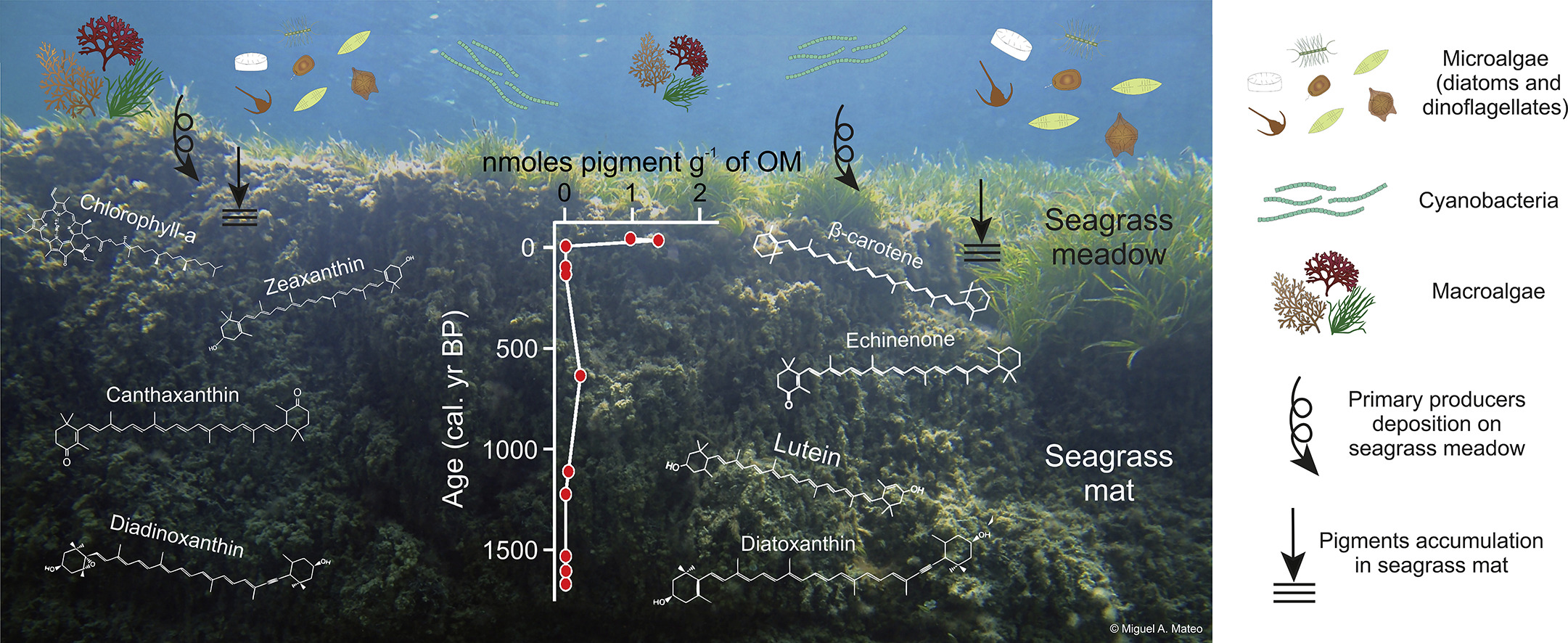
Carmen Leiva-Dueñas presents the first attempt to reconstruct long-term patterns in the phototrophic community associated with seagrass ecosystems.
Factors regulating primary producers’ assemblages in Posidonia oceanica (L.) Delile ecosystems over the past 1800 years Science of…