
Discovering Posidonia oceanica
Díaz-Almela,Elena. Post-Doc at the Centre for Advanced Studies of Blanes (CEAB-CSIC) in the Aquatic Macrophyte Ecology group (GAME)

The petiole and the leaf blade are flattened. The younger leaves are located in the centre of the shoot, as that is the position of the apical meristem, which, when dividing, produces leaves alternately to the left and right.

As the plant produces a permanent mark (node) at the junction of the rhizome with the base of each leaf, this allows the reconstruction of the plant's past growth, similar to the growth rings of trees (Fig. 3).

Posidonia It has clonal growth, where the repeating unit is the clump or shoot, consisting of a clump of leaves, a rhizome, and at least one root.
There are horizontal growth shoots, also called apices, which colonise the substrate, dividing several times a year, and growing annually between 1 and 10 cm. Their internodes can measure more than 1 centimetre.
But most shoots grow vertically. Seeking the light, they avoid being buried. Vertical shoots, with internodes of 1 or 2 millimetres (Fig. 2), usually do not grow more than 1 cm per year, except when reacting to intense burial, in which case they can grow up to 4 cm per year.
The plant compensates for its very slow growth with incredibly long-lived shoots, which can exceed 60 years. This, combined with the size of some clones, suggests that each plant as a whole can live for centuries or millennia, and some estimate between tens and hundreds of thousands of years, making it the longest-lived known species on the planet.
The accumulation of sediments and the slow vertical growth of the plant cause the meadow of Posidonia It rises over millennia, forming a kind of reef called a "mata" (Fig. 4), with very interesting environmental properties, as we shall see.

The shoots remain interconnected by the rhizome over several metres, exchanging nutrients and sugars. When uprooted, they have some chance of dispersing, taking root, and starting a new plant, colonising other locations (Fig. 4).

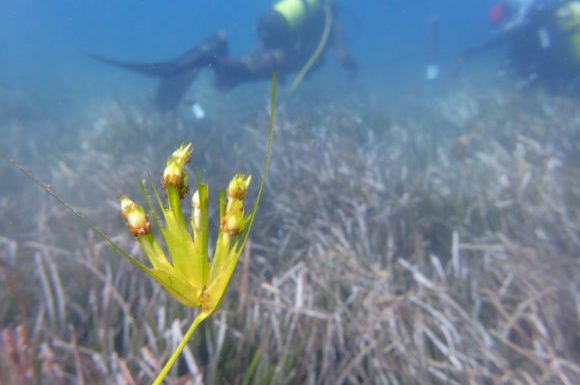
Although Posidonia oceanica It reproduces mainly vegetatively, but it is also capable of sexual reproduction. Some years, in autumn, the meadows bloom. The shoots produce green inflorescences, composed of spikelets with hermaphrodite flowers (with ovary and stamens) and male flowers (stamens only, Fig. 5).

The pollen of marine plants is adapted to water and is dispersed by currents. The pollen of Posidonia It is elongated and flexible, and it sticks to the female stigma as soon as it comes into contact with it (Fig. 7).

The fruit of Posidonia oceanica It has a single seed and resembles an olive. That is why they are called "sea olives" (Fig. 8.a and 8.b).


When the seed is mature and germinated, the fruit splits open, dropping it to the ground. It takes root and grows if the conditions are suitable (Fig. 10).

Related Posts
The CEAB celebrates Ocean Night
Within the European Researchers' Night, the Blanes Advanced Studies Centre…
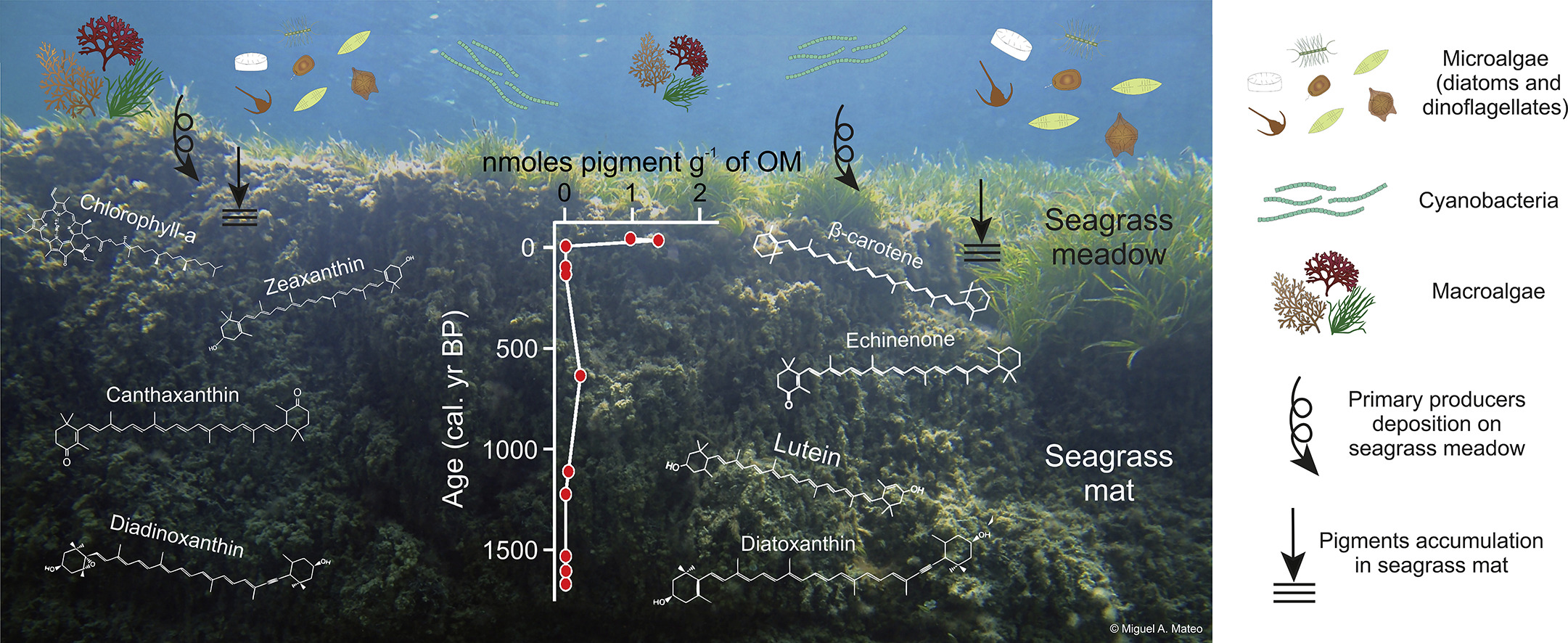
Carmen Leiva-Dueñas presents the first attempt to reconstruct long-term patterns in the phototrophic community associated with seagrass ecosystems.
Factors regulating primary producers’ assemblages in Posidonia oceanica (L.) Delile ecosystems over the past 1800 years Science of…